Ecosystem Report · September 2026
Largest Federal Contract Awards, August 2026 (Civilian): $13.5 Billion Signed, as Homeland Security Runs at 3.8× Last Year
The monthly read of the federal contract record, as of the 6 September 2026 federal data release. Civilian agencies signed 136,119 new contracts and orders in August worth $13.5 billion at signing — about the same money as August 2025 (up 17% once recurring Veterans Affairs payment orders are set aside in both years), on 12% fewer awards, most of that difference in General Services Administration small orders. The fiscal year's larger movement sits at one department: Homeland Security's contract obligations are running at 3.8 times last year's pace. Defense figures in this issue stop at May, for a reason explained below.
Intelligent Win · Market Intelligence — measured on intelligent.win’s contract corpus.
<!-- DRAFT v3 (capture-sme + gtm + commercial-launch + data-objector corrections applied) — ecosystem-intel-analyst, 2026-09-23. Pipeline: capture-manager-sme → gtm-strategist tease-check (BEFORE charts) → charts → commercial-launch-advisor → data-objector → founder sign-off. Every figure traces to NUMBERS-MANIFEST.md. Company names appear only as data rows in the award tables. -->
This is the monthly read of the federal prime contract record, as of the 6 September 2026 federal data release. It carries contract actions through 4 September.
Four things stand out.
August’s new civilian contracting carried the same money as last August on 12% fewer awards — most of the difference is in General Services Administration small orders. Civilian agencies signed 136,119 new contracts and orders in August 2026, carrying $13.49 billion at signing. In August 2025 it was 154,626 worth $13.33 billion. Of the 18,507 fewer awards, 12,434 — two-thirds — were GSA orders, almost all under $1 million. Set aside the recurring Veterans Affairs payment orders described below, in both years, and new civilian money rose from $9.38 billion to $11.01 billion — up 17%.
The fiscal year’s biggest movement is at one department. From 1 October through 31 August, civilian contract obligations reached $312.8 billion, against $243.4 billion over the same window a year earlier — up 28.5%. The Department of Homeland Security accounts for $45.7 billion of that $69.4 billion increase. DHS obligations went from $16.3 billion to $62.0 billion: 3.8 times last year’s pace (3.4 times on positive obligations alone).
Defense is not in the August numbers, and that is a publication delay, not a spending story. Department of Defense contract records in this release end in the first week of June. Every defense figure below stops at 31 May.
And for pipeline planning: 56,119 services contracts and orders reach their current end date between October and March with no option period left on the record — 311 of them carry half the money. Details, and the limits on reading them, are below.
Civilian agencies unless marked. Federal prime contract record, 6 September 2026 release.
Read this first: the defense record ends in early June
Department of Defense contract records in this release stop in the first week of June. That is the Department of Defense’s roughly 90-day delay before its contract records are published, not a drop in spending: the government’s own live figures, checked 23 September, show June 2026 defense obligations of about $28.6 billion, against $8.73 billion in this file. DoD-awarded obligations here read $49.47B in May, then $8.73B, $0.05B and $0.02B for June through August. The same months of 2025 read $35.66B, $39.56B, $43.20B and $43.07B. Civilian agencies show no gap (August $28.76B vs $28.77B). The missing months will fill in over the next three releases.
What that means for this issue:
- The August award list is civilian. It is labelled that way everywhere it appears.
- Every defense comparison stops at 31 May, the last complete month in the file, in both years.
- Any all-agency total for June through August 2026 would be wrong by roughly the size of the defense budget. We do not print one.
Any “largest awards of August” list built from the public contract file is civilian, whether it says so or not.
Largest federal contract awards, August 2026 (civilian)
These are the ten largest new civilian contracts and orders signed in August 2026, ranked by the dollars obligated on the day they were signed. “New” means the award’s first action — its base transaction — is dated in August; later modifications to older contracts are not counted.
| # | Awarding agency | What the government’s record describes | Awardee | Type | Obligated at signing |
|---|---|---|---|---|---|
| 1 | Veterans Affairs | Government health-insurance program order, “Express Report: June 2026” | TriWest Healthcare Alliance Corp | Order under an existing vehicle | $983.90M |
| 2 | Veterans Affairs | Government health-insurance program order, “Express Report: July 2026” | TriWest Healthcare Alliance Corp | Order under an existing vehicle | $798.68M |
| 3 | NASA | Design, development, integration, launch and on-orbit communications for a Mars Sample Return mission and future Mars missions | Blue Origin, LLC | New contract | $660.00M |
| 4 | GSA, Public Buildings Service | Design-build of the Raul Hector Castro Land Port of Entry, Douglas, Arizona | Hensel Phelps Construction Co. | New contract | $374.88M |
| 5 | DHS, Immigration and Customs Enforcement | Operational and maintenance support for government-furnished aircraft | Eastern Air Express LLC | New contract | $215.52M |
| 6 | GSA, Federal Acquisition Service | Managed services for government-owned pharmaceuticals, medical supplies and equipment | Integrated Quality Solutions, LLC | New contract | $162.14M |
| 7 | Veterans Affairs | Pharmacy benefit management order, “Express Report: PBM Apr–Jul FY26” | OptumRx Administrative Services, LLC | Order under an existing vehicle | $159.20M |
| 8 | HHS | Legal services (“Legal Services Bridge 2.0”) | Our Rescue | New contract | $158.12M |
| 9 | Treasury, Internal Revenue Service | Integrated Enterprise Portals 1.5 bridge | Accenture Federal Services LLC | Order under an existing vehicle | $144.18M |
| 10 | Veterans Affairs | Pharmacy benefit management order, “Express Report: PBM Jun–Sep FY25” | OptumRx Administrative Services, LLC | Order under an existing vehicle | $136.95M |
The ten together obligated $3.79 billion at signing — 28% of the month’s new civilian money.
Read the Veterans Affairs rows for what they are. Four of the ten are orders whose government description begins “Express Report” followed by a reporting period. Across the month, 251 Veterans Affairs orders carry that description, totalling $2.48 billion — 18.4% of all new civilian money signed in August. Their descriptions name past service months. Our assessment — it is not a field in the record — is that these are periodic payments against existing vehicles, most of the money on two health-care vehicles, not new programs, and a reader comparing months should treat them that way. August 2025’s comparator carried $3.96 billion of the same orders; set them aside in both years and new civilian money rose from $9.38 billion to $11.01 billion.
Two of the ten — the HHS legal-services award and the IRS portals order — carry the word “bridge” in the government’s own description. The record does not say what follows either one.
Beyond the top ten, the month’s largest new standalone contracts included two Federal Aviation Administration control-tower construction awards (San Jose, $100.92M; a second tower and radio replacement, $74.90M), an ICE contract for armed ground transportation ($100.47M), a Veterans Affairs hospital boiler replacement ($88.19M), and a NASA design-build facility at Marshall ($61.99M).
The platform’s contract record — every modification in order, whether it was competed, the vehicle it rode in on, and the office that bought it — is described here.
Where August’s new civilian money went
| Category | New contracts and orders | Obligated at signing | Share |
|---|---|---|---|
| Products and supplies | 118,489 | $3.75B | 27.8% |
| Professional and management support | 7,138 | $2.28B | 16.9% |
| Construction | 1,497 | $2.21B | 16.4% |
| Other services | 7,548 | $2.20B | 16.3% |
| Social and health-insurance programs | 238 | $1.85B | 13.7% |
| IT and telecom services | 1,209 | $1.21B | 9.0% |
| Total | 136,119 | $13.49B |
The count and the dollars live in different places. 15 awards of $100 million or more carried $4.31 billion — 32.0% of the month’s money. At the other end, 134,625 awards under $1 million — 98.9% of everything signed — carried $2.56 billion, 19.0%. The General Services Administration alone placed 115,541 new contracts and orders in August — 115,432 of them under $1 million — carrying $1.38 billion. Outside GSA, new civilian awards went from 26,651 in August 2025 to 20,578 (−22.8%), on $12.65 billion and $12.11 billion. Awards of $1 million or more, across all civilian agencies, went from 1,186 to 1,494 on nearly the same dollars ($10.89 billion and $10.94 billion).
Civilian contract obligations, FY2026 through August
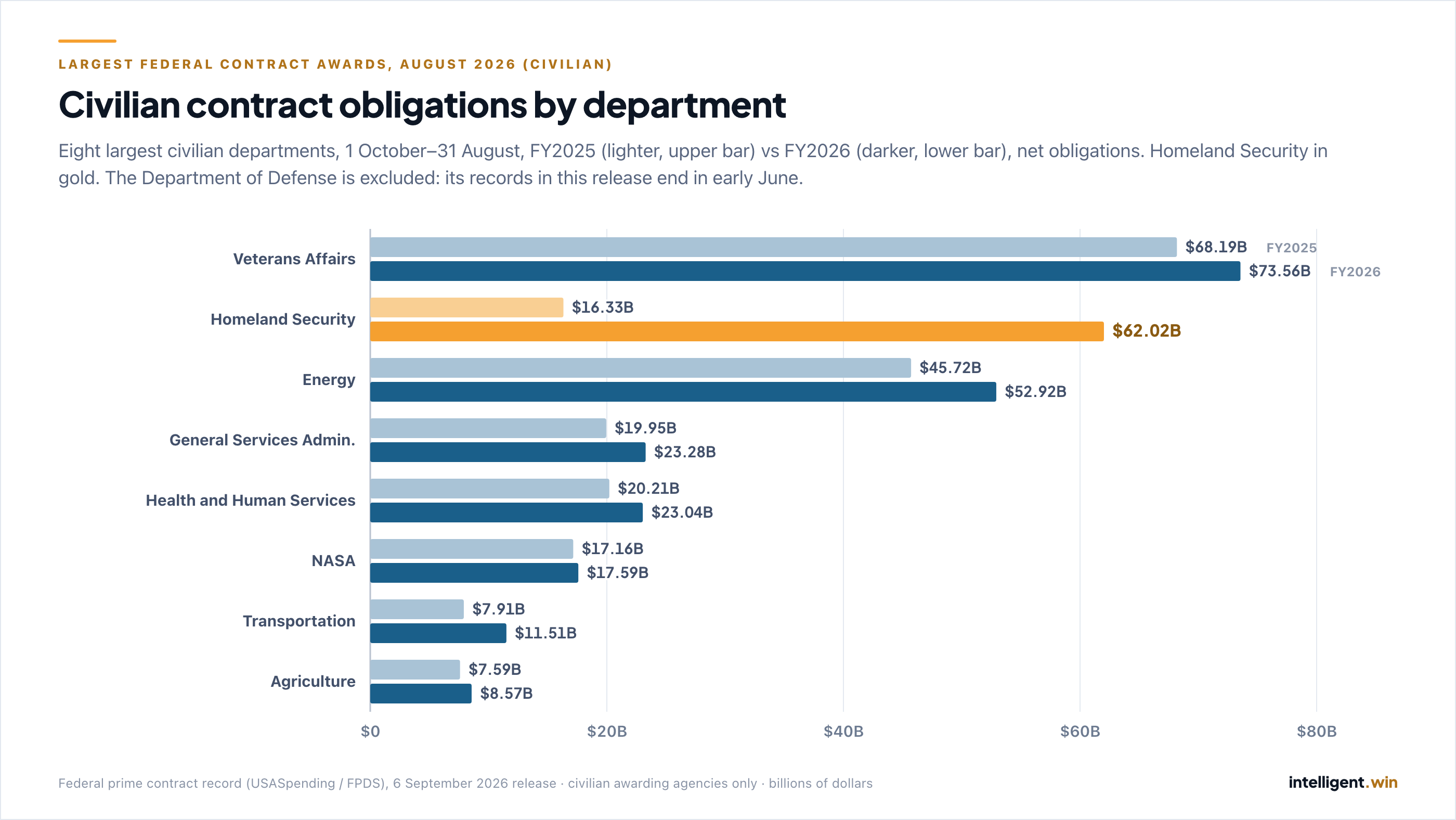
From 1 October 2025 through 31 August 2026, civilian agencies obligated $312.76 billion in prime contracts, against $243.35 billion over the identical window of FY2025 — +28.5%.
Two checks before reading that as growth. First, the net figure includes deobligations, which were unusually heavy last year: $21.75 billion of deobligations in the FY2025 window against $15.58 billion this year. On positive obligations alone the increase is smaller but still large: $265.10 billion to $328.34 billion, +23.9%. Second, the increase is concentrated.
| Civilian department (eight largest) | FY2025, 1 Oct–31 Aug | FY2026, 1 Oct–31 Aug | Change |
|---|---|---|---|
| Veterans Affairs | $68.19B | $73.56B | +$5.37B |
| Homeland Security | $16.33B | $62.02B | +$45.69B |
| Energy | $45.72B | $52.92B | +$7.20B |
| General Services Administration | $19.95B | $23.28B | +$3.33B |
| Health and Human Services | $20.21B | $23.04B | +$2.84B |
| NASA | $17.16B | $17.59B | +$0.43B |
| Transportation | $7.91B | $11.51B | +$3.60B |
| Agriculture | $7.59B | $8.57B | +$0.98B |
Homeland Security accounts for 65.8% of the entire civilian increase. On positive obligations alone, DHS went from $18.81 billion to $63.90 billion — 3.4 times, against 3.8 times net, because last year’s DHS figure was pulled down by deobligations. Take it out and the rest of the civilian government rose from $227.02 billion to $250.74 billion — +10.4%. DHS went from 6.7% of civilian contract obligations to 19.8%.
Inside DHS, three components carry it:
| DHS component | FY2025, 1 Oct–31 Aug | FY2026, 1 Oct–31 Aug |
|---|---|---|
| Customs and Border Protection | $3.19B | $33.84B |
| Coast Guard | $2.20B | $12.20B |
| Immigration and Customs Enforcement | $2.58B | $7.51B |
Below the component level, the platform’s Customer pages open each federal buying office — who wins there, how it buys and how competitive its work is — described here.
And across all civilian agencies, the category that moved most was construction: $10.83 billion to $43.39 billion, four times last year, and nearly half (46.9%) of the civilian increase on its own. Customs and Border Protection construction went from $0.63 billion to $27.74 billion over the same window — 63.9% of all civilian construction obligations this fiscal year.
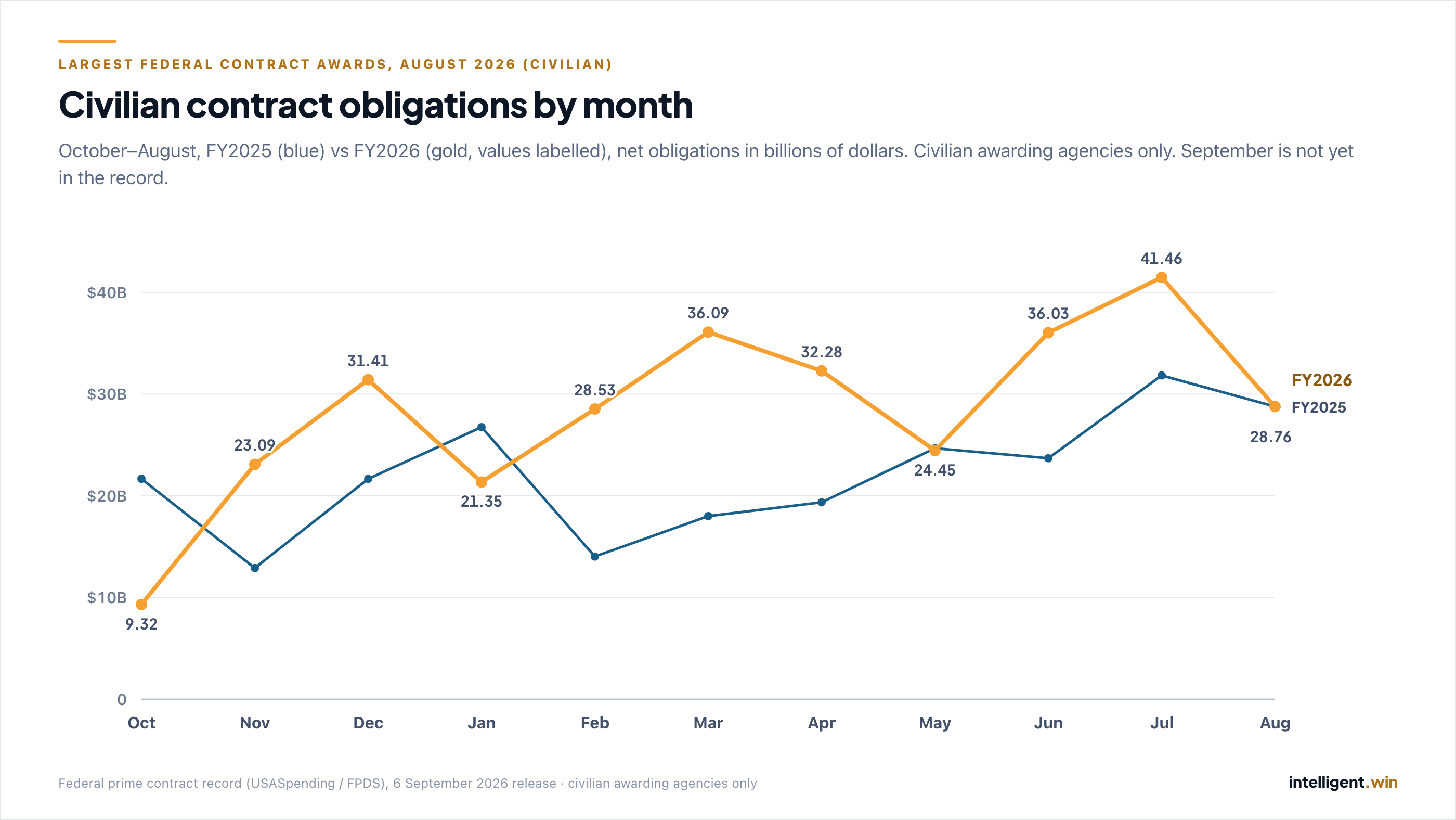
The monthly path matters too. Civilian obligations in July 2026 reached $41.46 billion, against $31.83 billion in July 2025. August came back to last year’s level. September is not yet in the record.
Defense, through May
Measured over the window where the defense record is complete in both years — 1 October through 31 May — Department of Defense contract obligations reached $322.97 billion in FY2026, against $273.58 billion in FY2025: +18.1%. Defense services obligations rose from $137.28 billion to $156.10 billion (+13.7%) while the number of defense services awards fell from 162,419 to 136,537 (−15.9%).
That last pair — more money, fewer awards — shows up on the civilian side too: civilian services obligations rose 24.9% over October–August on 13.6% fewer services awards. It is the pattern we examined in August in Half of Federal Services Dollars Now Ride on 419 Awards, still visible with more data.
Federal services contracts reaching their end date, October 2026–March 2027
Between 1 October 2026 and 31 March 2027, 56,119 federal services contracts and orders reach the current end of their period of performance with no further option period on the record. Together they have obligated $223.48 billion since FY2020. “Services” here follows the standard product-or-service-code cut, so it includes 7,711 construction contracts and orders.
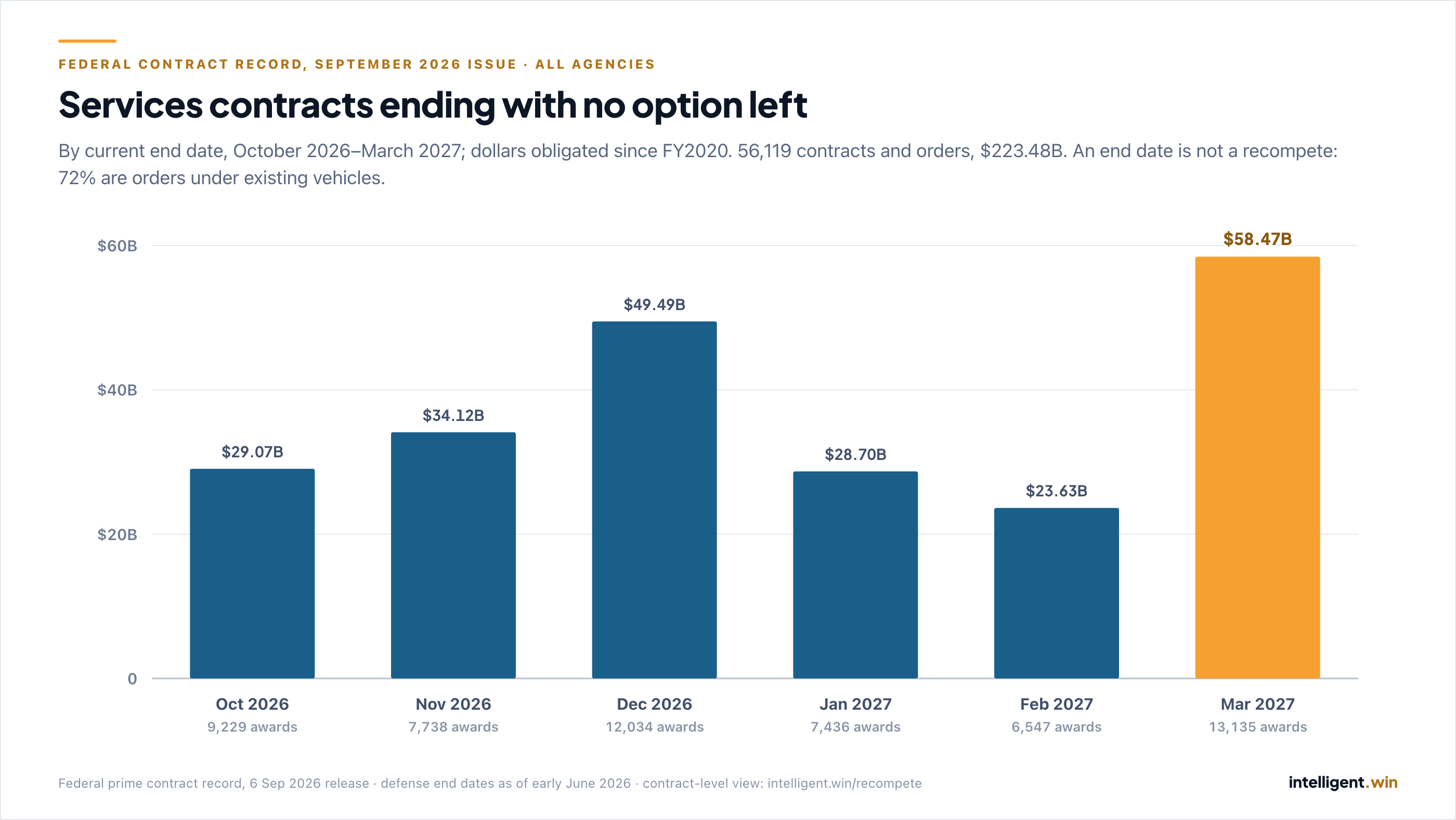
| Current end date | Services contracts and orders, no option period left | Obligated since FY2020 |
|---|---|---|
| October 2026 | 9,229 | $29.07B |
| November 2026 | 7,738 | $34.12B |
| December 2026 | 12,034 | $49.49B |
| January 2027 | 7,436 | $28.70B |
| February 2027 | 6,547 | $23.63B |
| March 2027 | 13,135 | $58.47B |
| Total | 56,119 | $223.48B |
Working one of these contracts — the incumbent’s federal award record, the real days left on its period of performance, and the government’s own scope language where it has been extracted, on one page — is what the Recompete Brief workflow is for.
The dollars are concentrated: 311 of them have obligated $100 million or more and carry $112.93 billion — 50.5% of the total. 2,822 have obligated $10 million or more.
By department, defense accounts for 26,830 of these contracts and orders ($113.56 billion), Veterans Affairs 5,179 ($32.21 billion), Homeland Security 1,885 ($10.60 billion), Health and Human Services 2,464 ($9.96 billion), and GSA 2,796 ($9.72 billion).
A further 20,870 services contracts and orders also reach their current end date in the window but still carry option periods on the record — $116.84 billion obligated since FY2020. Those are option-exercise decisions rather than end-of-contract dates.
Four honest limits on this list:
- An end date is not a recompete. 40,653 of the 56,119 — 72.4% — are orders under an existing contract vehicle. Many will be followed by a new order under the same vehicle, not a new competition.
- Defense end dates are three months stale. Modifications signed by the Department of Defense after early June — including extensions — are not yet public, so some defense contracts on this list have already been extended, and some defense contracts not on it will end in the window.
- The dollars are obligations since FY2020, not contract value. Our record begins with FY2020, so a long-running contract shows only its obligations from that year forward.
- “No option period left” means none shown on the record. Agencies can still extend services contracts, including under the standard six-month option to extend services, which the record’s potential end date may not reflect.
What we will check in October
In August we published four falsifiable predictions about September 2026 in The September Cliff. They cannot be tested yet: this release ends on 4 September.
- The civilian half can be tested when the mid-October release lands, and we will report it then.
- The full test, defense included, has to wait for the January release, when the defense September records become public. We will not grade an all-agency prediction on a civilian-only file, and we will say so when the October issue runs.
What this does not tell you
- Why DHS contracting grew. The record shows which components obligated the money and on what categories of work. It does not show which appropriation funded it, and this report does not assign one.
- Anything about individual companies beyond the award facts shown. The award table lists the government’s own record of who was awarded what. It is not a ranking of firms and makes no claim about any company’s size or standing.
- The size of the defense summer. June through August 2026 defense contracting will not be measurable until the next three releases fill it in.
- Subcontracts. The September subaward release landed on 23 September. Subcontract reporting carries its own lag and its own data-quality rules, and it will be treated in a later issue rather than rushed into this one.
Where the platform picks up
<!-- CLEARED by commercial-launch-advisor 2026-09-23 (edits applied). PUBLISH-DAY CHECK: re-fetch / and confirm id=“contract” and id=“customer” still exist (else delete those two pointers); re-check /recompete and /capability-search copy; /plans still 404 — keep omitted. -->
This report stops at aggregates on purpose. The contract-level view — a specific expiring contract, its incumbent’s federal award record and, where it has been extracted, the government’s own scope language — is covered on intelligent.win/recompete. Finding the companies whose federal awards demonstrate a given kind of work — described in plain English, ranked by how many of those awards there are and what they were worth — is covered on intelligent.win/capability-search.
These numbers came out of the platform, not a spreadsheet.
The same contract corpus behind this note — 2.6 million contracts, reconciled against the government’s own published totals before anything publishes — is what the product runs on. If you want to see how it’s assembled and checked, that’s written up in full.